

Exercise and Brain Health: Have We Put Too Much Faith in New Neurons?
Warm-up
One often reads or hears that we need to take care of our brains because we have only a limited supply of “brain substance” and our “brain cells” cannot divide. But to what extent is this true? Are new neurons generated in the adult central nervous system? And does size really matter in the brain? In this post, we discuss the biological basis of these questions and how regular exercise may influence specific brain structure and cognitive function.
Most mature neurons do not divide, but this does not mean that the adult brain is entirely incapable of producing new ones. Early evidence came from rodent experiments, including the pioneering work of Joseph Altman and Gopal Das in the 1960s [1]. These studies challenged the idea that neuron production ends early in life. We now distinguish between the division of existing mature neurons and neurogenesis: the production of new neurons from neural stem and progenitor cells.
One region where adult neurogenesis has been demonstrated in rodents is the dentate gyrus, part of the hippocampus. The hippocampus supports memory formation and spatial navigation, while its dentate gyrus-CA3 circuitry contributes to pattern separation: keeping similar experiences distinct in memory. For example, can I remember whether the green parrot I saw yesterday had a red or an orange beak, without confusing it with another, very similar bird? This is more than simply noticing a visual difference; it involves maintaining distinct representations of overlapping experiences.
The hippocampus also helps us recognise familiar locations and uses spatial cues to work out where we are. Substantial damage to both hippocampi can severely impair the formation of new episodic memories - memories of events and experiences -, a difficulty familiar to viewers of the film Memento, although the film is a fictional illustration rather than a clinical account. A classic study of hippocampal structure was conducted in the United Kingdom by Eleanor Maguire and colleagues [2]. They found that London taxi drivers - who undergo extensive training to learn London’s streets and routes - had larger posterior hippocampi than control participants. However, the anterior hippocampi were larger in the controls. The finding therefore concerned regional differences, rather than a uniformly larger hippocampus (Fig. 1).
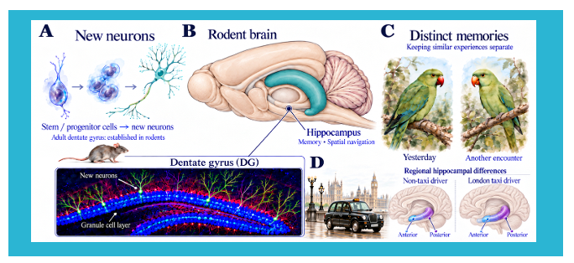
Fig. 1. The hippocampus: neurogenesis, memory and spatial navigation. (A) Neural stem and progenitor cells give rise to new neurons, a process established in the adult rodent dentate gyrus. (B) Rodent brain showing hippocampal location, with a schematic dentate gyrus inset illustrating rodent neurogenesis. (C) Similar parrots illustrate overlapping experiences that hippocampal circuits help keep distinct through pattern separation. (D) London taxi-driver findings concern regional hippocampal differences rather than uniform enlargement.
Training Session
Some of the first experiments linking adult hippocampal neurogenesis with regular physical activity were conducted by Henriette van Praag and colleagues [3]. In their 1999 work, voluntary wheel running increased the number of newly generated neurons in the mouse hippocampus and improved spatial learning and memory.
The big question is how these mainly rodent findings - and their proposed mechanisms - translate to humans. Our knowledge in humans remains constrained by technological and ethical limitations. In rodent experiments, researchers commonly investigate new cell formation using bromodeoxyuridine, or BrdU, a synthetic analogue of thymidine. BrdU becomes incorporated into DNA during DNA synthesis in dividing cells. Researchers subsequently examine brain tissue and combine BrdU detection with neuronal markers to identify cells that have developed into neurons.
This procedure cannot routinely be used to study neurogenesis in healthy human volunteers, particularly because it requires subsequent examination of brain tissue. However, it is not entirely correct to say that it has never been used in humans: a landmark 1998 study examined post-mortem tissue from patients who had received BrdU for cancer-related diagnostic purposes and reported evidence of adult hippocampal neurogenesis [4]. More recent molecular work has also identified proliferating neural progenitor cells in the adult human hippocampus [5]. These findings support the existence of this process, but do not establish how strongly exercise stimulates it in humans.
Human exercise studies therefore commonly rely on magnetic resonance imaging, or MRI, to measure brain structure. MRI allows researchers to follow hippocampal volume over time, but a change in volume is not direct evidence of new neuron formation. Volume reflects several tissue components and cannot, by itself, distinguish neurogenesis from changes in existing neurons, glial cells or blood vessels.
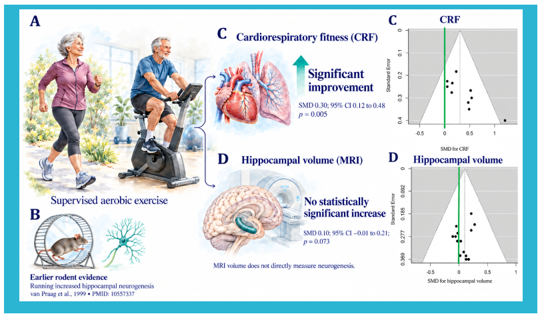
Fig. 2. Aerobic exercise improves fitness without a clear increase in hippocampal volume. Pooled trials in healthy older adults showed improved CRF but no statistically significant increase in hippocampal volume. Funnel plots show individual effect estimates against standard error; added teal lines mark zero effect. Illustration recreated based on the original work of Balbim et al., GeroScience 46:2755–2764, 2024. A nonsignificant result does not establish a zero effect or exclude cognitive benefits.
In 2011, Kirk Erickson and colleagues published a seminal 12-month randomized controlled trial involving 120 older adults [6]. The aerobic exercise group showed an approximately 2% increase in hippocampal volume, concentrated in the anterior hippocampus, whereas the stretching control group experienced a decline. Within the aerobic exercise group, changes in hippocampal volume were associated with changes in serum brain-derived neurotrophic factor, or BDNF. This protein supports neuronal survival and synaptic plasticity and is implicated in neurogenesis.
There was a problem, however: subsequent studies did not consistently reproduce the finding. A meta-analysis by Balbim and colleagues combined eight randomized trials reported across nine publications [7]. It included 554 cognitively unimpaired, healthy older adults, with an average age of approximately 68 years. Participants completed supervised aerobic exercise programs lasting 3–12 months, typically exercising three times per week for around 44 minutes per session (Fig. 2).
The pooled results showed that aerobic exercise significantly improved cardiorespiratory fitness but did not produce a statistically significant increase in hippocampal volume. Furthermore, improvements in fitness were not associated with changes in hippocampal volume across studies. These findings suggest that aerobic training does not reliably produce measurable hippocampal enlargement under the conditions examined. However, the data do not suggest that the effect is exactly zero or that exercise provides no cognitive benefits.
Cool down
Why do findings in mice and humans differ? Partly because we often measure different things: newly formed neurons in animal tissue versus hippocampal volume on human MRI. Species differences, exercise dose, and measurement timing may also contribute. The expansion-renormalization model offers another possible explanation: an initial increase in tissue volume may be followed by refinement, allowing volume to return towards baseline while function remains improved. Scans taken only before and after an intervention could miss this intermediate change, although the meta-analysis did not establish whether this process has occurred.
Crucially, the absence of significant growth does not rule out functional benefits. Erickson and colleagues’ trial linked exercise-related hippocampal changes with improved spatial memory, highlighting why structural measurements should be considered alongside what the brain can do.
So, have we put too much faith in new neurons? Perhaps - if we treat their formation as the main explanation for exercise’s cognitive benefits in humans. Newly generated neurons may represent only a small fraction of the neuronal population, and their functional contribution need not produce a measurable increase in brain volume. Changes in synaptic plasticity, circuit function and connectivity may be more important than size alone; neurogenesis remains a plausible part of the puzzle, but its contribution to exercise-related benefits in humans is still uncertain. Exercise has been shown to improve aspects of brain function, but the brain is one of the most complex structures in nature. The Latin phrase mens sana in corpore sano - “a healthy mind in a healthy body” - offers a fitting aspiration, even if the biology is more complex than the saying.
References
- Altman J, Das GD. Autoradiographic and histological evidence of postnatal hippocampal neurogenesis in rats. J Comp Neurol. 1965;124(3):319–335. doi: 10.1002/cne.901240303. PMID: 5861717
- Maguire EA, Gadian DG, Johnsrude IS, Good CD, Ashburner J, Frackowiak RS, et al. Navigation-related structural change in the hippocampi of taxi drivers. Proc Natl Acad Sci U S A. 2000;97(8):4398–4403. doi: 10.1073/pnas.070039597. PMID: 10716738
- van Praag H, Christie BR, Sejnowski TJ, Gage FH. Running enhances neurogenesis, learning, and long-term potentiation in mice. Proc Natl Acad Sci U S A. 1999;96(23):13427–13431. doi: 10.1073/pnas.96.23.13427. PMID: 10557337
- Eriksson PS, Perfilieva E, Björk-Eriksson T, Alborn AM, Nordborg C, Peterson DA, et al. Neurogenesis in the adult human hippocampus. Nat Med. 1998;4(11):1313–1317. doi: 10.1038/3305. PMID: 9809557
- Dumitru I, Paterlini M, Zamboni M, Ziegenhain C, Giatrellis S, Saghaleyni R, et al. Identification of proliferating neural progenitors in the adult human hippocampus. Science. 2025;389(6755):58–63. doi: 10.1126/science.adu9575. PMID: 40608919.
- Erickson KI, Voss MW, Prakash RS, Basak C, Szabo A, Chaddock L, et al. Exercise training increases size of hippocampus and improves memory. Proc Natl Acad Sci U S A. 2011;108(7):3017–3022. doi: 10.1073/pnas.1015950108. PMID: 21282661.
- Balbim GM, Boa Sorte Silva NC, Ten Brinke L, Falck RS, Hortobágyi T, Granacher U, et al. Aerobic exercise training effects on hippocampal volume in healthy older individuals: a meta-analysis of randomized controlled trials. Geroscience. 2024;46(2):2755–2764. doi: 10.1007/s11357-023-00971-7. PMID: 37943486.


