
Video meliora proboque, deteriora sequor.
I see and approve of the good, but I still choose the bad. Ovid, Metamorphoses
Warm-up
Welcome to our monthly sports science blog! It might seem that the last thing the world needs is another health and fitness blog, as these make up 15% of the 600 million active and dormant blogs published on the internet. However, sports science and health-related blogs rarely set the aim to provide evidence-based interpretations and explanations for a phenomenon. The overall aim of this blog is to fill this gap.
Our sports science blog is intended for the curious. Those will learn the most who have an appetite for a deeper understanding the physiological, biomechanical, and neuromuscular basis of movement and performance analyses and the mechanisms of adaptations to training performed by athletes and exercise performed by individuals across the lifespan. Kinesiology, physical education, and physical therapy students, coaches, movement therapists, geriatricians, gerontologists, physicians, and the general population can all benefit from the up to date and evidence-based information, always highlighting practical benefits.
The aim of this opening blog is to set the tone and recap the health benefits of physical activity and exercise with respect to healthy aging: how and to what extent physical activity and exercise can prevent and reduce disease prevalence and prolong health-span, i.e., the portion of seniors can live in relatively good health. Experimental research has identified four pillars of healthy aging: physical activity, diet (eating to feel 80% full), sleep, and having a sense of purpose to live. The present blog focuses on the role of physical activity and exercise in disease prevention and health maintenance through the lifespan.
Training session
Movement in its endless forms is perhaps the most potent medicine of all. Even just a few minutes of physical activity that raises heart and respiratory rates and contracts muscles forcefully, perturbs the internal balance of cells, i.e., homeostasis. Such perturbations are not harmful in healthy individuals. Just the opposite. Indeed, one bout of 30-minutes-long treadmill walking can modify the level of 9,815 molecules in the blood, indicating system-wide effects [4]. Physical activity is any bodily movement that increases energy expenditure above rest, while exercise is a planned and structured form of physical activity that includes repetitive movements [5]. As Fig. 1 details the potency of exercise: when we repeat a bout of exercise as part of an exercise program over years [5-7], functional and structural adaptations ensue according to the type of exercise and health benefits accrue [8]. The downward pointing arrows on the left side of Fig.1 illustrate how healthy aging affects the structure and function of bodily systems. However, the adjacent upward pointing arrows denote how physical activity and exercise can diminish these unfavorable effects hence slow aging and potentially extend life.
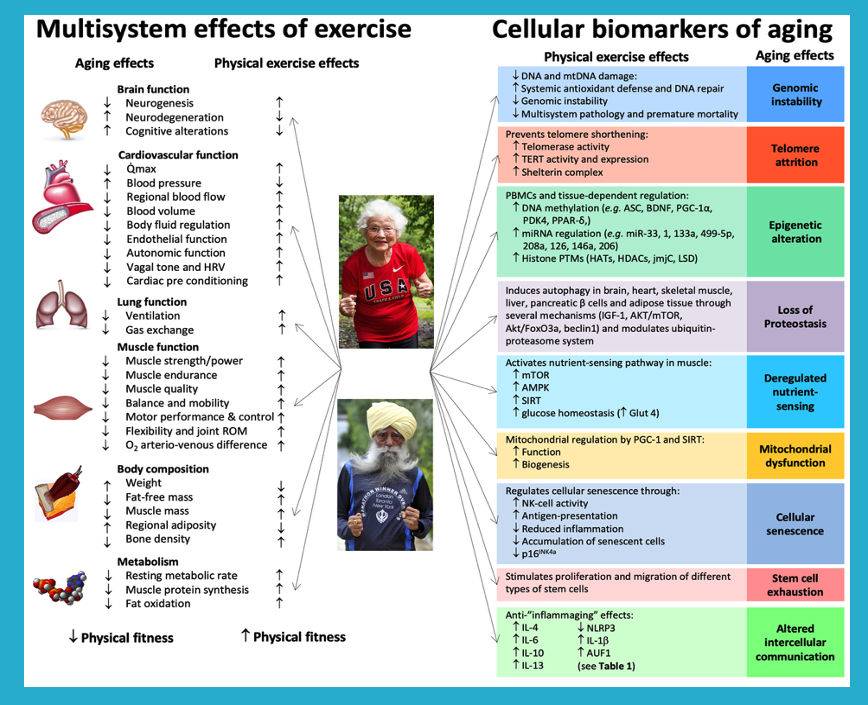
Fig. 1. Physical activity and exercise modify cellular biomarkers of aging (right side) and slows aging through improvements in systemic function (left side). Middle lower image: Fauja Singh (at age 108) ran his last competitive race in 2013 at the age of 101, finishing the Hong Kong Marathon's 10-km race in 1 h 32 min 28 s (credits: Wikipedia). Middle upper image: Julia 'Hurricane' Hawkins at the age of 104, is a senior sprint world record holder in her age group (credits: Gerontology Wiki). Concerning cellular biomarkers of aging (right panel), there is a debate if functional tests trump molecular and epigenetic biomarkers in predicting biological age and longevity [2]. Modified after [3].
Government agencies recommend 75 vigorous-intensity or 150 moderate-intensity minutes per week (or 7.5 metabolic-equivalent hours per week) of aerobic activity to experience health benefits of exercise [5, 6]. Changing from a sedentary state by adding 20 minutes of moderate and 10 minutes of vigorous intensity exercise daily thereby meeting government guidelines, reduced mortality risk the most by 20%. (Fig. 2) [1]. Mortality risk decreased by a total of ~40% with an increase in exercise dose. The reason for the eight percent increase in mortality risk at the very high exercise dose is unclear. It could signify deaths of those who were previously sedentary and started to exercise vigorously with undetected a cardiac or cardiovascular problem. It can also reflect the recently discovered cardiovascular vulnerability among senior runners [9]. Still, master athletes can live beyond age 100 (Fig.1, middle), reflecting the lower mortality risk among aging long-distance runners and cyclists [10, 11].
Fig. 2 shows that exercise is a potent medicine, but it can only do so much good on its own, as ~60% mortality risk remains unaccounted for. Combining exercise with (Mediterranean) diet, 6-8 hours of sleep and up to five more favorable behavioral modifications can reduce cancer, cardiovascular, respiratory, digestive, and all-cause mortality risk by ~60%, extending life potentially by 6-8 healthier years [12-18]. The molecular mechanisms of how exactly sleep (S), physical activity (P), And Nutrition (N), i.e., SPAN behaviors act upon each other to extend life are not fully understood. It seems that good sleep facilitates the actions of hunger hormones ghrelin and leptin so that people can keep hunger and overeating in check. Good sleep is also associated with sufficient levels and adequate timing of growth hormone release and optimal parasympathetic tone, the neural activity that keeps the body calm and balanced. Such neuro-hormonal actions facilitate exercise-induced immune defense and the repair of muscle damage. In addition, high volume and intensity physical activity and exercise can to some extent buffer elevated cardiometabolic risks and immune dysfunction induced by poor sleep and diet. The bidirectional interaction among SNAP behaviors is the likely reason that the overall risk reduction due to SNAP exceeds the sum of risk reductions produced by each behavior alone. This interaction gives rise to the ‘minimum dose effect’: only 15 minutes of extra sleep, small favorable changes in diet (replacing ultra processed foods with vegetables), and a few minutes more of moderate-to-vigorous exercise can reduce mortality risk by up to 50%. Genetic predisposition to diseases is still substantial and high-intensity exercise compared with lower intensity and smaller dose recommendations may afford the greatest cardiovascular protection [19].
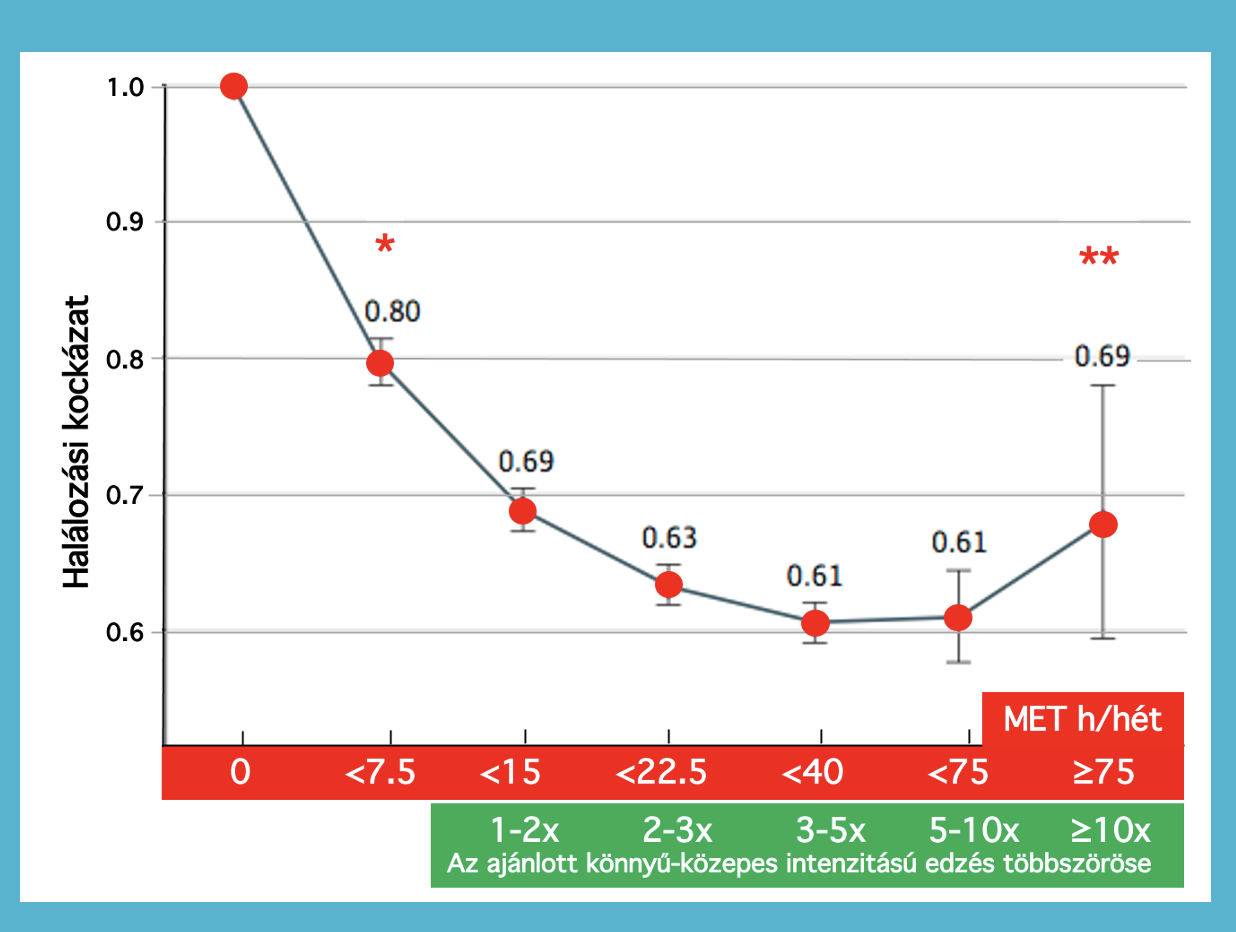
Fig. 2. Dose effects of physical activity and exercise on mortality risk in over 660,000 men and women. The greatest reduction of 20%* in mortality risk occurs when one shifts from a sedentary state (mortality risk of 1.0) to a level of physical activity that corresponds to ~7.5 MET h/week energy expenditure. One MET is the energy expenditure at rest. Mortality risk further decreases with increases in physical activity and slightly rises at an exercise dose used by marathon runners**. This high level of exercise is over 10 times more than the minimum levels of light-to-moderate physical activity recommended (LTPA, green axis). The reductions in mortality risks were adjusted for sex, smoking, alcohol consumption, educational level, marital status, history of cancer and heart disease, and body mass index. Modified after [1].
Cool-down
So, why is it beneficial to be physically active? Fig. 1 summarizes the evidence suggesting that physical activity and exercise can help prevent disease and maintain health at any point in life, especially if performed with peers or groups. But physical activity seems to play an outsized role in health-span in late-life. When we manage three of the four pillars of healthy aging, the fourths element, a sense of purpose in life, might come easier. Acting on the four pillars of healthy aging puts an emphasis on quality instead of quantity of life because less can be more: a bit shorter life lived healthily is much more enjoyable than a bit longer life lived in poor health. Move to live and live to move! That’s a healthy and good choice, Ovid!
Sources
- Arem H, et al. Leisure time physical activity and mortality: a detailed pooled analysis of the dose-response relationship. JAMA Intern Med. 175:959-67, 2015.
- Furrer R, et al. Biomarkers of aging: functional aspects still trump molecular parameters. NPJ Aging. 11:15, 2025.
- Garatachea N, et al. Exercise attenuates the major hallmarks of aging. Rejuvenation Res. 18:57-89, 2015.
- Contrepois K, et al. Molecular Choreography of Acute Exercise. Cell. 181:1112-30 e16, 2020.
- Garber CE, et al. American College of Sports Medicine position stand. Quantity and quality of exercise for developing and maintaining cardiorespiratory, musculoskeletal, and neuromotor fitness in apparently healthy adults: guidance for prescribing exercise. Med Sci Sports Exerc. 43:1334-59, 2011.
- World Health Organization W. WHO guidelines on physical activity and sedentary behaviour. . Geneva: World Health Organization; 2020.
- Luo M, et al. Dose-response interplay between light and moderate-to-vigorous physical activity on all-cause mortality risk: a causal inference analysis. Br J Sports Med. 60:941-50, 2026.
- Furrer R, et al. Biomarkers of aging: from molecules and surrogates to physiology and function. Physiol Rev. 105:1609-94, 2025.
- O'Driscoll J, et al. Resting and exercise-induced occult hypertension and coronary atherosclerosis in male masters endurance athletes. Br J Sports Med. 60:1227-37, 2026.
- Chakravarty EF, et al. Reduced disability and mortality among aging runners: a 21-year longitudinal study. Arch Intern Med. 168:1638-46, 2008.
- Marijon E, et al. Mortality of French participants in the Tour de France (1947-2012). Eur Heart J. 34:3145-50, 2013.
- Chudasama YV, et al. Healthy lifestyle and life expectancy in people with multimorbidity in the UK Biobank: A longitudinal cohort study. PLoS Med. 17:e1003332, 2020.
- da Silva WA, et al. Joint association of physical activity and sleep duration with all-cause and cause-specific mortality: A prospective study of 153,866 Mexican adults. Maturitas. 199:108656, 2025.
- Koemel NA, et al. Minimum combined sleep, physical activity, and nutrition variations associated with lifeSPAN and healthSPAN improvements: a population cohort study. EClinicalMedicine. 92:103741, 2026.
- Koemel NA, et al. Combined variations in sleep, physical activity, and nutrition and the risk of major adverse cardiovascular events. Eur J Prev Cardiol. 2026.
- Liang YY, et al. Joint association of physical activity and sleep duration with risk of all-cause and cause-specific mortality: a population-based cohort study using accelerometry. Eur J Prev Cardiol. 30:832-43, 2023.
- Stamatakis E, et al. Minimum and optimal combined variations in sleep, physical activity, and nutrition in relation to all-cause mortality risk. BMC Med. 23:111, 2025.
- Wang N, et al. Association of a healthy lifestyle with mortality risk among individuals with osteoarthritis: a prospective cohort study of the UK Biobank. BMJ Open. 15:e092558, 2025.
- Liang Z, et al. Joint non-linear dose-response associations of device-measured physical activity and cardiorespiratory fitness with cardiovascular disease: a cohort and Mendelian randomisation study. Br J Sports Med. 60:1238-49, 2026.


